SYSTEM ARCHITECTURE
The Infrastructure of Tomorrow.
The Hybrid AI Network
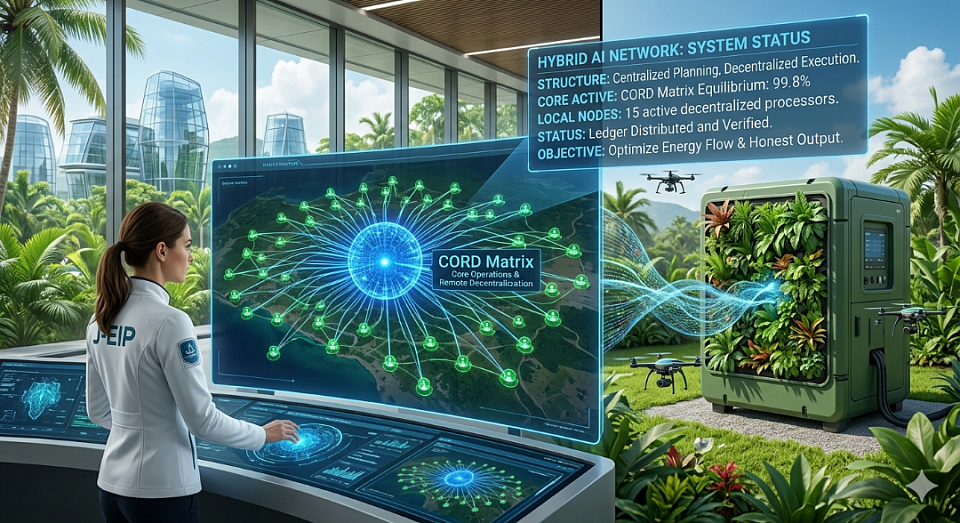
Hybrid A.I System.
The nervous system of the GJOS is an exclusively engineered Hybrid AI Network.
Its core logic is centralized, governed by a singular, immutable objective: to monitor Honest Output, equitably distribute Joules, and maintain an unbiased public ledger.
Simultaneously, its physical architecture is decentralized, processing data through thousands of independent nodes located at production facilities and labor centers.
This hybrid design guarantees global cohesion while ensuring complete resilience against single points of failure or localized corruption.
How the Hybrid AI Network Interfaces with Wearables.
The Human-Node Connection
The precision of the GJOS depends on the removal of subjective labor assessments.
To facilitate this, the Hybrid AI Network interfaces directly with individuals via specialized smart glasses and advanced biometric wearables.
These devices function as your personal, decentralized nodes within the broader network. While engaged in physical or cognitive tasks, the wearables securely monitor vital metrics—such as caloric expenditure, spatial movement, and task completion—converting your biological effort into real-time data.
This data is immediately anonymized and authenticated by local processing stations before being relayed to the central CORD Matrix.
Since the wearables quantify the exact physical exertion (1 kcal = 4,184 J) and the precise cognitive focus required for your role, your Honest Output is computed with absolute mathematical fairness.
Compensation is no longer subject to a supervisor’s discretion; instead, it is determined by an incorruptible ledger that objectively measures and values your energy.
The Tri-brid Grid System

Solar, Wind, Green Hydrogen.
To sustain a resilient, energy-secured economy, we depend on a robust Tri-brid Grid System.
By integrating three independent renewable energy sources—advanced solar, wind, and green hydrogen—this grid guarantees a continuous and reliable energy baseline.
It powers production facilities, supports residential needs, and ensures uninterrupted operation of the Hybrid AI Network.
Operation of the Tri-brid Grid System.
The Unwavering Energy Baseline
The GJOS engine requires absolute stability; an energy-backed economy cannot endure power disruptions.
The Tribrid Grid System achieves this by seamlessly integrating three distinct renewable energy sources into a cohesive, intelligent network.
Advanced solar arrays and vertical-axis wind turbines provide the majority of the park’s kinetic and radiant energy under favorable environmental conditions. Nonetheless, due to weather fluctuations, the system relies on its third and most critical component: Green Hydrogen.
When solar and wind systems generate surplus energy, the Hybrid AI Network immediately channels the excess power to onsite electrolysis facilities, where water is split to produce and store pure green hydrogen.
During intervals of diminished solar and wind output—such as nighttime or calm weather—the grid effortlessly draws from the stored hydrogen reserves to maintain the baseline.
This closed-loop process operates as a large-scale, continuous battery, ensuring that our production plants, residences, and AI infrastructure consistently receive the 1 kWh = 3,600,000 Joules required to sustain the deflationary economy.